
cursor
h a t t a n m e d a
Get a quote

Law Firm SEO Services for Attorneys

Search work an attorney signs off on, built inside Google's rules on doorway pages, reviews and paid links.

Our law firm SEO services are for solo attorneys and firms that want to be found when someone searches Google for legal help. We plan pages around the problems people search for, set up Google profiles for the firm and its attorneys, and handle reviews and links within Google's policies. One of your attorneys approves every page, and we flag titles, badges and keyword ads for your counsel where lawyer advertising rules apply.

  • Attorney-approved pages
  • Town pages, no doorways
  • Firm and attorney profiles
  • Replies that keep confidences
  • Comparison and keyword rules

Let’s get started on your project.

A few lines about your business and what you need is plenty.

Or call +1 646 820 8499, or write to [email protected].

What our law firm SEO services include

Law firm SEO is work on your pages, Google profiles, reviews and links, aimed at the people who search Google for legal help. We handle each of these:

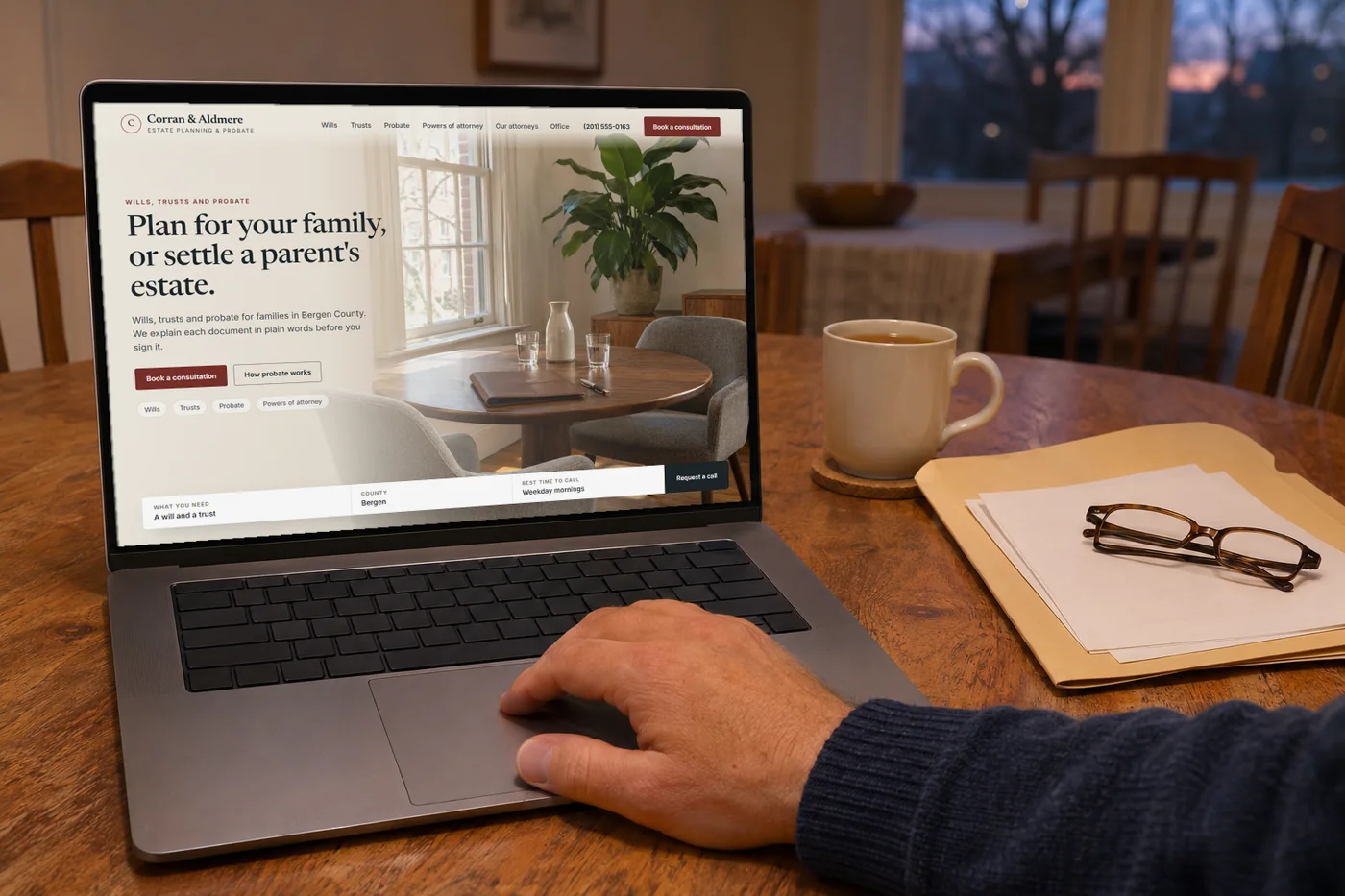
A laptop on a dining table showing a concept website for Corran & Aldmere, an invented estate planning firm
A concept design we made for Corran & Aldmere, an invented law firm. It is not a client site.
  • Pages for the problems and practice areas clients search for, each approved by one of your attorneys.
  • Town and county pages where the firm takes matters and has something to say.
  • Titles, descriptions and badges flagged for your counsel when they compare you with other lawyers.
  • Business Profiles on Google for the firm and its eligible attorneys.
  • A review request sent in the same words to each client, and reply drafts that keep confidences.
  • Links and directory listings, with paid links marked the way Google asks.
  • A monthly report pairing our changes with your Search Console numbers.

Pages for the problem, the practice area and the town

We sort the searches a firm's pages answer into three groups. Some name the problem in the client's own words, like a deposit a landlord won't return, and others pair a practice area with a place, like a divorce lawyer in Hackensack. The third kind is urgent: an arrest last night, or eviction papers served this week.

A problem search goes to a page about that problem, and a practice area search to the practice page, written the way our web design for law firms page describes. An urgent page opens with the phone number and the hours someone answers the phone.

Google's spam policies list substantially similar pages that sit closer to search results than to a clear, browsable hierarchy as doorway abuse. We give a town or county a page only where the firm takes matters there and can say something true of that place alone, such as the courthouse those cases go to.

Legal content, and the attorney who signs it off

Google's guide to helpful, reliable, people-first content suggests asking three questions about each page: who created it, how and why. It strongly encourages accurate authorship information such as bylines, and it calls fabricated author profiles, with made-up names or false credentials, a form of deception.

The same guide asks whether an expert who knows the topic well wrote or reviewed the page. We draft each page from an interview with the attorney who handles that work. That attorney corrects it and approves it, and the page names them as its reviewer, with a link to their bio.

Titles, descriptions and badges under New Jersey's RPC 7.1(a)

New Jersey's RPC 7.1(a), as the Supreme Court quoted it in In re Opinion No. 735, sets out what makes a lawyer's communication false or misleading. Under (a)(2), that includes one likely to create an unjustified expectation about results the lawyer can achieve.

Under (a)(3), a communication that compares the lawyer's services with other lawyers' services is misleading unless all three of these hold:

  • The name of the comparing organization is stated.
  • The basis for the comparison can be substantiated.
  • The communication includes, in a readily discernable manner, the disclaimer "No aspect of this advertisement has been approved by the Supreme Court of New Jersey".

If a page title, a description or a badge compares you with other lawyers or hints at an outcome, we flag it for your counsel, with the three conditions beside any comparison. For New York's Rule 7.1, read our law firm web design page, and in any other state, check your own state's rules.

We're not a law firm, and nothing here is legal advice. Your firm's ethics counsel, or your state's own rules, have the final word on anything we draft.

Buying another lawyer's name as a keyword

On May 22, 2025, the New Jersey Supreme Court held that using a competitor's name or law firm's name in keyword advertising doesn't violate the Rules of Professional Conduct. An attorney who buys a competing attorney's or firm's name for a keyword campaign must now put this disclaimer on any landing page the paid ad leads to:

"You arrived at this page via a paid advertisement on [insert name of search engine provider] through paid keyword search results. This website and the legal business it describes are affiliated only with [insert name of purchasing attorney] and the other attorneys referenced within this website."

A footnote tells attorneys to ensure the disclaimer is prominently displayed. If your firm runs these ads, we put the filled-in wording near the top of each landing page they point to. Bidding, budgets and ad copy belong to our Google Ads management service.

Firm listings, attorney listings and shared offices

Google counts lawyers as individual practitioners in its Business Profile guidelines, and a practitioner's profile can carry a title or degree such as JD or Esq.

Each attorney who deals with the public, and whom clients can contact directly at the verified office during the posted hours, can have a profile of their own. Google allows each practitioner one profile, however many specializations they cover. For an office with several public-facing practitioners, Google asks the firm to create a separate profile, and the title on each attorney's profile should hold the attorney's name only, with no firm name.

If you meet clients in rented space, check Google's address rules. A virtual office, an address you rent but don't work from, isn't eligible. For a co-working office, Google sets three conditions: signage that's clear, clients received there in business hours, and your own staff on site through those hours.

We find each profile Google shows for the firm and its lawyers and mark what needs to change. Our local SEO services page explains setup, verification and category choice.

Asking for reviews, and answering criticism

Google's Maps content policy bars a business from selectively soliciting positive reviews or discouraging negative ones. It rules out payment, discounts or free services in exchange for a review, and asking for specific content, such as a staff member's name. You can ask for reviews of genuine experiences, as long as you don't offer an incentive or try to steer the rating or the words.

The request we set up goes out in the same words after each matter closes, whatever the result, and it doesn't ask the client to name an attorney.

In New York, NYSBA Ethics Opinion 1032 concludes that a lawyer may not disclose confidential client information solely to respond to a former client's criticism on a website that carries client reviews of lawyers. It reads the self-defense exception in Rule 1.6 as reaching a lawyer who faces some kind of formal proceeding, such as a lawsuit or a disciplinary complaint. Our reply drafts say nothing about the matter, and an attorney at the firm reads each one before it goes up.

Links and legal directories

Google's link spam policy names buying links for ranking purposes and low-quality directory links among its examples. The same section says buying and selling links is a normal part of the web for advertising and sponsorship, and such links don't break its policies when they carry rel="nofollow" or rel="sponsored".

Google's page on qualifying outbound links asks sites to mark advertisements and paid placements with rel="sponsored". The tag goes on the page that carries the link, so on a paid listing it's up to the directory, and on your site we add it.

The State Bar's comment to New York's Rule 7.2 says the rule doesn't stop a lawyer paying for advertising the rules permit, including online directory listings and search engine optimization. Apart from the exceptions it names, the comment says lawyers may not pay others to recommend them, and a communication that vouches for a lawyer's credentials, abilities, competence or character counts as a recommendation. Your ethics counsel can sort your listings by that line.

Starting with your firm

  1. You name the matters you want more of, the counties and courts you cover, and the attorney who approves pages.
  2. You share access to the site, Search Console and each Google profile tied to the firm or its lawyers.
  3. We review the site, the profiles, any badges and any keyword ads, and send you a ranked list of changes.
  4. We draft pages from attorney interviews, and the approving attorney edits and signs off on each one.
  5. We set up the review request and draft replies as reviews arrive.
  6. After that, we send the monthly report.

Who this fits, and when to wait

It's worth bringing us in if clients look for a firm like yours on Google, your site is live, and no one at the firm has time for pages, profiles and reviews.

Wait if a merger, a new firm name or a move is close, since we'd have to redo the profiles and pages that carry the old name and address. If the firm has no site yet, start with a law firm website. If your matters reach you some other way, tell us how and we'll say which parts we can take on.

What to have ready

  • The matters you want more of, and where you handle them.
  • An attorney to sign off on pages and review replies.
  • Owner details for each Google profile the firm or its lawyers have.
  • Any rating badges or paid directory listings you use now.
  • Admin access to the site, and to Search Console if it's set up.

Common questions

If yours isn't here, call +1 646 820 8499 or write to [email protected].

Is SEO for lawyers different from SEO for other businesses?

The search work is the same kind: pages, Google profiles, reviews and links. A law firm adds its state's rules for lawyer advertising, so an attorney at the firm approves each page, and we flag comparisons, results language and competitor keywords for your counsel.

Can a New York lawyer pay for SEO and directory listings?

The State Bar's comment to Rule 7.2 says the rule doesn't prohibit paying for advertising the rules permit, including online directory listings and search engine optimization. Apart from the exceptions it names, the same comment says lawyers may not pay others to recommend their services. Your ethics counsel decides which side a given listing falls on.

Can our New Jersey site show a rating badge?

If the badge compares you with other lawyers, RPC 7.1(a)(3), as the New Jersey Supreme Court quoted it in May 2025, calls for the comparing organization's name, a basis that can be substantiated, and the disclaimer "No aspect of this advertisement has been approved by the Supreme Court of New Jersey". Your ethics counsel decides whether a badge makes that comparison.

May we bid on a rival firm's name in Google Ads?

In New Jersey, the Supreme Court held on May 22, 2025 that using a competitor's name in keyword advertising doesn't violate the Rules of Professional Conduct. Attorneys who do it must put the Court's disclaimer on the landing page the ad leads to. In another state, check your own state's rules first.

Can our attorneys have Google profiles separate from the firm's?

Google's guidelines name lawyers as individual practitioners, and one who is public-facing and reachable at the verified location during stated hours can have a dedicated profile. Google also asks the firm to create a separate profile for an office with several public-facing practitioners.

What can a reply to a former client's bad review say?

In New York, NYSBA Ethics Opinion 1032 says a lawyer may not disclose confidential client information solely to respond to a former client's criticism on a website that carries client reviews of lawyers. Our drafts stay off the matter, and an attorney at the firm reads each one before it's posted.

Can we ask only our happiest clients for a review?

Google's Maps content policy doesn't allow a business to selectively solicit positive reviews or to discourage negative ones. The request we set up goes to clients in the same words after each matter closes.

Where does this stop and law firm web design begin?

Our web design for law firms service builds the site: practice area pages, attorney bios, intake forms and the basics of New York's Rule 7.1. This one works on how the firm gets found, from search planning and town pages to Google profiles, reviews, links and the rules that touch them.

Talk to us about your site