
cursor
h a t t a n m e d a
Get a quote

Dental SEO and Websites for Dentists

A page for each treatment, Google profiles for the practice and each dentist, and review replies that keep patient details private.

HattanMedia's dental SEO services are for practices that want more patients from Google search, from a solo general dentist to a group with several offices. We write a page for each treatment you offer, set up the Google profiles for the practice and its dentists, and draft review replies that say nothing about the patient. The website side comes with it: booking on each treatment page, a new-patient page and a layout built for phones.

  • Treatment pages
  • Practitioner profiles
  • Private review replies
  • Photo consent log
  • Booking on treatment pages

Let’s get started on your project.

A few lines about your business and what you need is plenty.

Or call +1 646 820 8499, or write to [email protected].

What our dental SEO services include

With dental SEO, we work to get your practice in front of nearby patients who search Google for a dentist or a treatment. The work comes in seven parts:

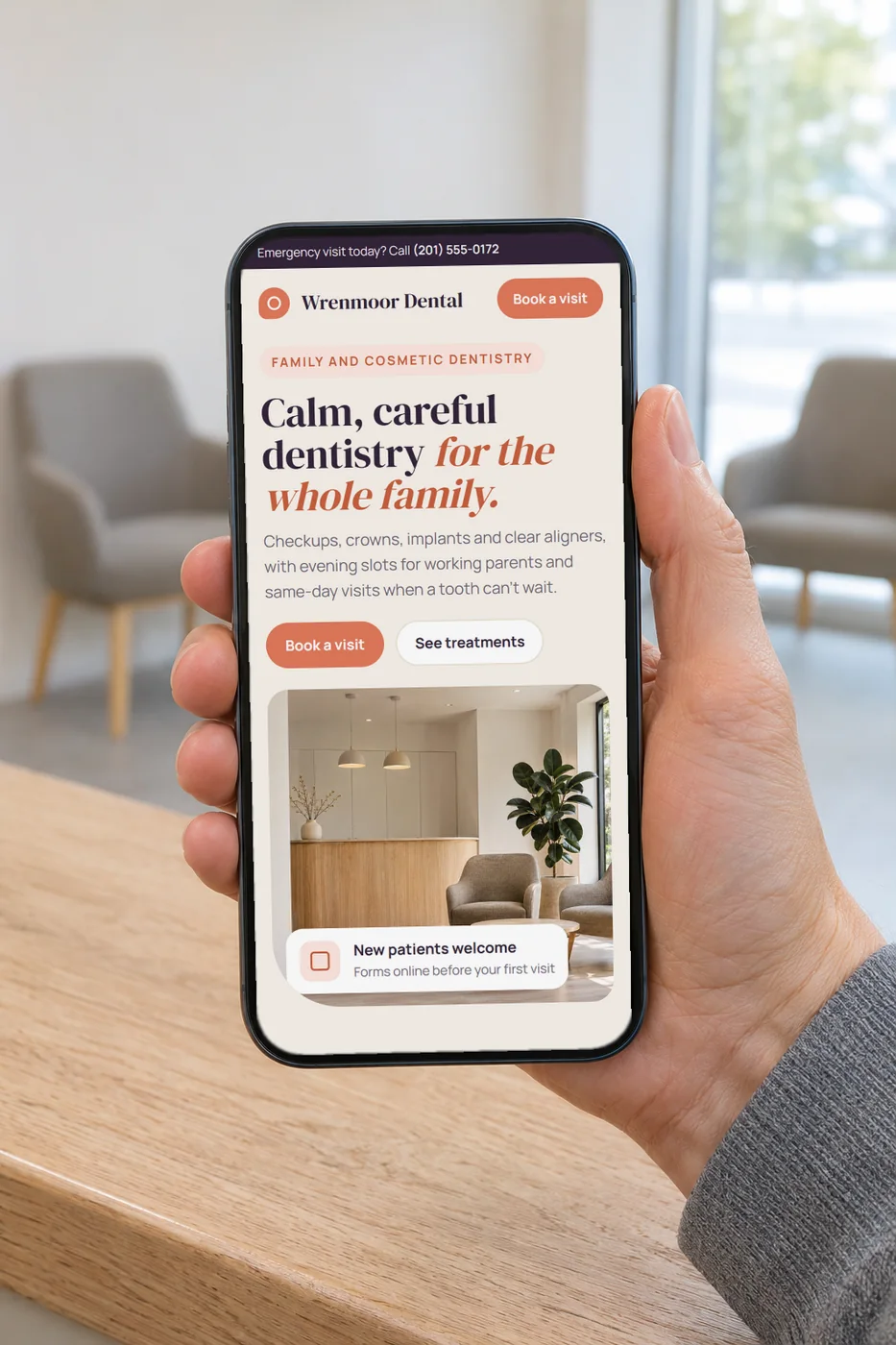
A phone at a dental reception desk showing a concept website for Wrenmoor Dental, an invented practice
A concept design we made for Wrenmoor Dental, an invented practice. It is not a client site.
  • A page for each treatment you offer, approved by your dentist.
  • Google profiles for the practice and for each dentist who sees patients.
  • Review replies that leave patient details out.
  • A log tying each patient photo or testimonial to its signed form.
  • A booking link and a call button on each treatment page.
  • A site that loads fast on a phone.
  • A monthly report: the changes we made and the clicks Search Console counted.

For profile setup, verification, categories and review reporting, we follow the steps on our local SEO services page.

The searches we plan your pages around

We plan a practice's pages around three kinds of search. A treatment search names the work, such as dental implants, a crown or clear aligners. An urgent search names the problem: a toothache, a broken tooth, an emergency dentist.

A town search adds a place, like a dentist in Teaneck or on the Upper West Side. For those, we rely on your practice profile and the address on each page.

A treatment search should land on that treatment's page. For urgent searches, we put your phone number and hours at the top of the page, with a plain line on whether you see emergency patients and when.

A page for each treatment, approved by your dentist

Each treatment you offer gets a page of its own, in the words a patient would use to ask about it. The page covers who the treatment suits, what happens at each visit, how many visits it takes and what recovery is like.

We write the drafts after an interview with you or your dentist. The dentist you name checks each clinical statement and approves the page before it goes live, and we keep a dated copy of each approved version.

New York's Rules of the Board of Regents count advertising that guarantees a service as unprofessional conduct, along with claims the licensee can't substantiate. The licensee carries the burden of proof, and section 29.5 applies these rules to dentists.

Section 29.5 also lets a dentist advertise a specialty only after completing specialty training the Board of Regents approves, or its substantial equivalent, and it treats "practice limited to" as a claim of special ability. So a general dentist's implant page describes the work without calling it a specialty.

A profile for the practice and one for each dentist

Google's guidelines for representing your business list dentists as individual practitioners. A dentist can have a dedicated profile if they work in a public-facing role and patients can reach them at the verified location during stated hours. Support staff shouldn't create profiles, and one dentist shouldn't have several to cover different specializations.

If several dentists see patients at one location, the guidelines say the practice should create its own profile for that location, separate from the dentists'. Each dentist's profile then takes the dentist's name alone as its title, without the practice name. Google allows a title or degree on a practitioner's profile, such as Dr.

If you're the only dentist patients see at a branded location, Google says it's best to share one profile with the brand, named in the form brand, colon, your name.

We list each profile that exists for the practice and its dentists, check it against these rules and send you the changes.

Replying to reviews without giving away patient information

HHS's Office for Civil Rights settled with New Vision Dental in California over the disclosure of patient information in response to online reviews. The HHS page says the practice used social media to respond to patient reviews, disclosing protected health information, and calls this illegal under HIPAA. New Vision Dental paid $23,000 and agreed to a corrective action plan.

In a separate case, OCR imposed a $50,000 civil money penalty on a dental practice with offices in Charlotte and Monroe, North Carolina. The practice had disclosed a patient's information on a webpage in response to a negative online review.

New York's Part 29 rules also treat revealing personally identifiable facts obtained in a professional capacity, without the patient's prior consent, as unprofessional conduct. Google's Business Profile guidelines don't allow content with private or confidential information, such as sensitive records.

Our draft replies leave out whether the reviewer is a patient, and they say nothing about a visit, a treatment or a bill. They thank the reviewer or ask them to call the office, and you post them.

Before-and-after photos and the HIPAA authorization

HIPAA's authorization rule says a covered entity may not use or disclose protected health information without a valid authorization, except where the rules permit or require it. A separate paragraph requires an authorization for any marketing use or disclosure, apart from face-to-face communication and promotional gifts of nominal value.

The rules' de-identification standard includes full-face photographs and comparable images in its list of identifiers of the individual.

A valid authorization describes the information in a specific way, names who may receive it and why, and gives an expiry date or event. It must be in plain language and carry the patient's signature and date. The patient gets a copy and can revoke it in writing.

Your compliance adviser decides which photos and stories need one. We add a photo or a patient's words to the site after you confirm the signed form is on file, and our log ties each one to its form, so we can take it down if the patient revokes.

Testimonials under New York and New Jersey rules

New York's Part 29 rules permit testimonials, demonstrations and other portrayals of professional practice on conditions. The patient has to authorize the portrayal in writing, the ad has to include disclosure that prevents misleading information or imagery about the patient's identity, and it needs reasonable disclaimers about statements made or results achieved. Fictional client testimonials aren't permitted.

The same rules require licensees who place advertisements to keep an exact copy of each one for a year after it last appears. If your adviser counts the website as advertising, you can use our dated copies of each approved page for that.

New Jersey's Board of Dentistry lists N.J.A.C. 13:30 as its rules on its laws and regulations page, and its 2024 readoption notice says Subchapter 6 sets forth requirements for advertising. Go through Subchapter 6 with your adviser before a photo or testimonial goes up for a New Jersey practice.

None of this is legal advice. Check each rule here with your own lawyer or compliance adviser before anything goes live.

Dental website design: booking, new patients and a fast phone layout

A patient who lands on a treatment page should be able to book from it. We put your booking link or a short request form near the top of each treatment page, with a call button beside it.

Your new-patient page covers the first exam, how long it takes, what to bring, and how to send x-rays from a previous dentist. We build the pages to load fast on a phone.

For accessibility, insurance lists and patient forms, see our web design for doctors and clinics page.

How we start with a practice

  1. You tell us the treatments you want more patients for, the towns your patients come from, and the dentist who approves clinical copy.
  2. You add us as a manager on the practice profile and each dentist's profile, and share logins for the site and Search Console.
  3. We check the profiles against Google's practitioner guidelines, review the site, and send you a list of changes in the order we'd make them.
  4. We draft the treatment pages, and your dentist corrects and approves each one.
  5. We set up the review-reply drafts and the log that ties each photo and testimonial to its signed form.
  6. Your first monthly report lists what we changed and the clicks Search Console counted from Google Search.

You stay the owner of each profile and account. Google's page on owner and manager roles gives the owner full control, including adding or removing users and deleting the profile.

When to bring in help with search, and when to wait

It's worth hiring help if patients find you on Google, you offer treatments you'd like more patients for, and your team has no time to write pages or answer reviews. A group practice with several dentists at one address fits too.

Wait if you're about to move, rename the practice or sell it, because the profiles and pages rest on the name and address. If there's no website yet, start with a small business website.

For paid placement, see our Google Ads management page. If you're unsure whether the practice fits, write to us about it and we'll say which parts we can take on.

Our offices are in Manhattan and Englewood, New Jersey, and we take on dental practices anywhere in the US.

What to have ready

  • Your treatments, with the ones you want more patients for marked.
  • The name of the dentist who'll approve clinical copy.
  • The Google account that owns the practice profile, and any profiles for individual dentists.
  • Your current authorization form for photos and testimonials, if you have one.
  • Logins for the website and Search Console.

Common questions

If yours isn't here, call +1 646 820 8499 or write to [email protected].

What do dental SEO services cover?

They cover the parts of your practice that nearby patients see when they look for a dentist on Google: treatment pages, the Google profiles for the practice and its dentists, review replies and the website. You also get a monthly report on what we changed.

Should each dentist in our practice have a Google Business Profile?

Google's guidelines say a dentist in a public-facing role, whom patients can contact at the verified location during stated hours, can have one. If several dentists work at one location, the practice should also have its own profile for that location. Support staff shouldn't have profiles.

Can we answer a review that gets the facts wrong?

Yes, with a reply that says nothing about the patient. HHS has announced enforcement actions against dental practices that disclosed patient information when responding to online reviews. Our drafts thank the reviewer or invite them to call the office.

Can we post before-and-after photos on the website?

Ask your compliance adviser which photos need a signed authorization, since HIPAA's de-identification rule lists full-face photographs among patient identifiers. New York's rules also require the patient's written authorization for portrayals of professional practice. We add a photo only after you confirm the form is on file.

Who checks the clinical facts on a treatment page?

Your dentist does. We draft the page from what you tell us, and the dentist you name corrects it and approves it before it goes live.

Can a general dentist have a page about implants or clear aligners?

Yes, if the page doesn't claim a specialty. New York's rules let a dentist advertise a specialty only after specialty training the Board of Regents approves, or its substantial equivalent. In New Jersey, your adviser can check the page against Subchapter 6 of the Board of Dentistry's rules.

How is this different from your local SEO service?

Local SEO covers the Google Business Profile for any kind of business. This service adds what a dental practice needs on top: profiles for each dentist, treatment pages, and care with patient privacy in reviews, photos and testimonials.

Do you take on practices in both New York and New Jersey?

Yes. Our offices are in Manhattan and Englewood, New Jersey, and we take on practices in other states as well.

Talk to us about your site